
Tools for Better Organizational Decisions

We get it. Everyone has a resource list now.
A folder of links. A saved post. A grant database. A Slack thread. A webinar replay. A toolkit someone swore would be useful. A new AI tool that promises to make everything easier.
The issue is not that information is unavailable. The issue is that most people are drowning in inputs and still trying to figure out what to do next.
“More information has not automatically created more capacity.”
Research is at our fingertips. So are templates, tools, programs, funding announcements, expert takes, and opportunity roundups. But access has created its own kind of overload. More information has not automatically created more capacity. More options have not automatically created better decisions.
That is the gap BPM is building into: the space between finding the resource and being ready to act on it.
Because the real question is rarely “Can I find something?”
The real question is:
Does this fit my situation?
Is this the right next step?
What context am I missing?
Who needs to be involved?
What decision does this actually help me make?
That is where resources become infrastructure.
The Pattern: Resources only matter when they help people decide
Across client work, community work, product development, and our own internal operations, we keep seeing the same pattern.
People do not only need more options. They need clearer pathways.
A resource list helps when someone already knows what they are looking for. A tool helps when the user already understands the decision in front of them. A recommendation helps when the context is obvious.
But in real operating environments, context is rarely obvious.
Leaders are managing limited time, uneven information, competing priorities, and decisions that cut across people, money, risk, identity, timing, and trust. Community organizations are navigating funding pressure, shifting eligibility requirements, and disconnected support systems. Founders and operators are trying to determine which opportunity, workflow, partner, or next step fits their actual stage.
The best tools do not just produce more information. They help people understand what fits, what matters, and what to do next.
The Signals
Tool access is not operational readiness
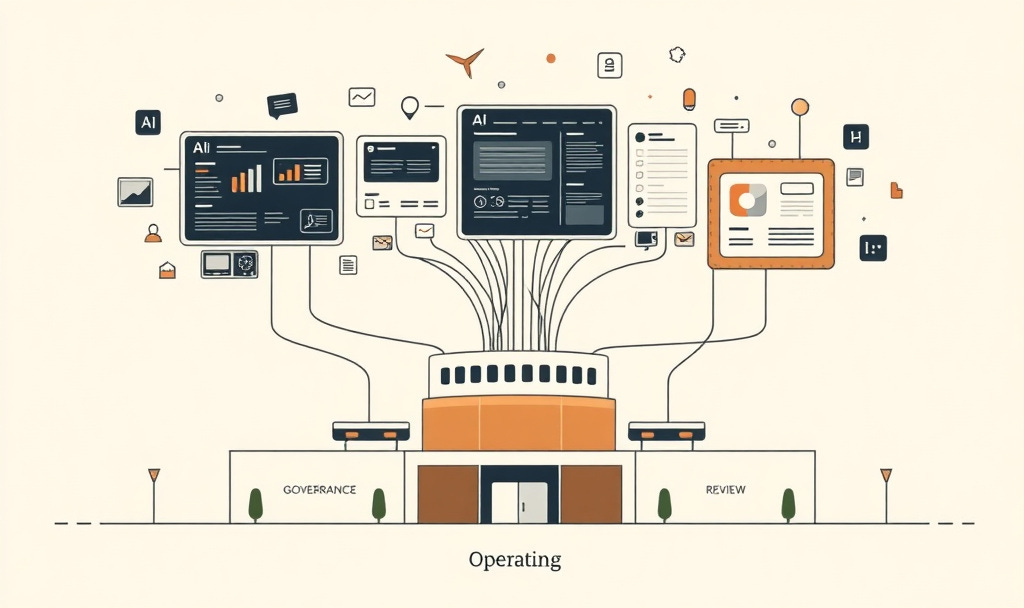
TechRadar reported this month that enterprise AI adoption is revealing a divide between organizations that have access to AI tools and organizations that embed those tools into workflows, governance, and operating models. The article cites McKinsey’s 2025 State of AI findings that 88% of organizations use AI in at least one business function, while only about one-third have begun scaling AI across the enterprise.
Source: TechRadar — “How AI is exposing enterprise operating models”
Workplace tools fail when they collapse context
A 2026 paper, “Context Collapse: Barriers to Adoption for Generative AI in Workplace Settings,” argues that generative AI tools often fall short in workplace environments because they do not adequately account for users’ real contexts. The authors describe how context can collapse or degrade over time, reducing the usefulness of systems meant to support work.
Source: arXiv — “Context Collapse: Barriers to Adoption for Generative AI in Workplace Settings”
Misaligned tools create workplace risk
A 2026 HCI paper analyzing 1,524 workplace AI incident reports found that as many as 83% of incidents stemmed from worker-AI misalignments. Workers often wanted systems that were more precise, insightful, or personal, but received systems that were basic, simple, or general.
Source: arXiv — “The Quiet Path from Seemingly Minor Design Errors to Workplace AI Incidents”
Verification gaps block production use
A 2026 study of agentic AI adoption across twelve companies found a capability-deployment verification gap. Some organizations had higher-level experimental AI capabilities but did not integrate them into production workflows because adequate output-verification mechanisms were absent.
Source: arXiv — “Agentic AI in Industry: Adoption Level and Deployment Barriers”
Nonprofits are operating under resource strain

Axios reported in May 2026 that U.S. nonprofits are facing pressure from funding cuts, rising demand, and inflation. The article cites Center for Effective Philanthropy survey data finding that 66% of 380 foundation-funded nonprofits expressed concern about financial stability.
Source: Axios — “Nonprofits say they are in a crisis”
What We’re Building: Public tools for better decisions
This is why BPM is opening up more of its operating layer.
We are not launching products because products are trendy. We are building public tools because the people and organizations we serve need clearer decisions, better routing, and more trustworthy infrastructure.
B. Pagels-Minor Products: the high-context decision layer
The B. Pagels-Minor product layer is focused on high-context decision support: tools for people, teams, and organizations navigating choices where identity, timing, risk, resources, and strategy all matter.
These are the decisions where generic advice breaks down. A leader does not only need a template. A founder does not only need a checklist. A team does not only need a summary. They need context that helps them understand the real shape of the decision in front of them.
This product layer is built from a simple belief: better decisions require better context, not just more information.
Explore the B. Pagels-Minor product page and tell us which decision, workflow, or organizational moment needs better support.
Lumenfolk Products: the everyday decision-support layer
Lumenfolk is our home for tools that help people move through friction with more confidence.
Some decisions are institutional. Some are personal. Many are both.
The products we are building here are designed to make common but stressful decisions easier to navigate, especially when people are managing limited time, limited context, or too many disconnected options. This is where decision infrastructure becomes human-scale: life admin, transitions, preparation, comparison, planning, and the small moments that become heavy when the pathway is unclear.
Visit the Lumenfolk product page, try one tool, and tell us where it helped clarify the next step — or where it still needs work.
Opportunity Resource Hub: the resource-routing layer
The Opportunity Resource Hub is designed for people and organizations looking for programs, funding, tools, and resources without relying on insider access or scattered word-of-mouth.
It is one of the ways we are testing a simple idea: resources become more powerful when people can find them, submit them, sort them, and use them in context.
We are building it for the organizations, founders, community leaders, and operators who do not have time to search across dozens of disconnected channels just to figure out what support exists.
Explore the Opportunity Resource Hub, submit a resource, or tell us what kind of opportunity is still too hard to find.
What We’re Learning: Every tool is also a listening surface
Public tools are not only distribution channels. They are feedback infrastructure.
When people use a tool, they show us where the pathway is clear and where it breaks. They show us which questions come up again and again. They reveal what context is missing, what language creates confusion, which resources are hard to classify, and where the next useful layer needs to be built.
That feedback matters.
We want the community to use these tools and tell us what happens. Tell us where a tool helped you move forward. Tell us where it left you uncertain. Tell us what you searched for and did not find. Tell us what decision still feels unsupported.
The public layer only becomes useful if it learns from the people using it.
From B.’s Desk
We see this consistently: people are not stuck because they lack intelligence, effort, or access to more information. They are stuck because the pathway from information to action is underbuilt.
In client work, this shows up as repeated decisions that never become documented workflows. In community work, it shows up as resources that exist but remain hard to find, compare, or use. In product development, it shows up when a tool gives an answer but not enough context for someone to trust the next step.
That is why we are building public decision infrastructure across BPM, Lumenfolk, and the Opportunity Resource Hub. These tools are live enough to be useful, early enough to be shaped, and public enough for the community to help us improve them.
Use them. Test them. Tell us where they work and where they do not. That feedback is part of the build.
Explore the B. Pagels-Minor product layer and tell us which high-context decision, workflow, or organizational moment needs better support:
Visit Lumenfolk, try one tool, and tell us where it helped clarify the next step — or where it still needs work:
Explore the Opportunity Resource Hub, submit a resource, or tell us what kind of opportunity is still too hard to find:
What Leaders Should Do Now
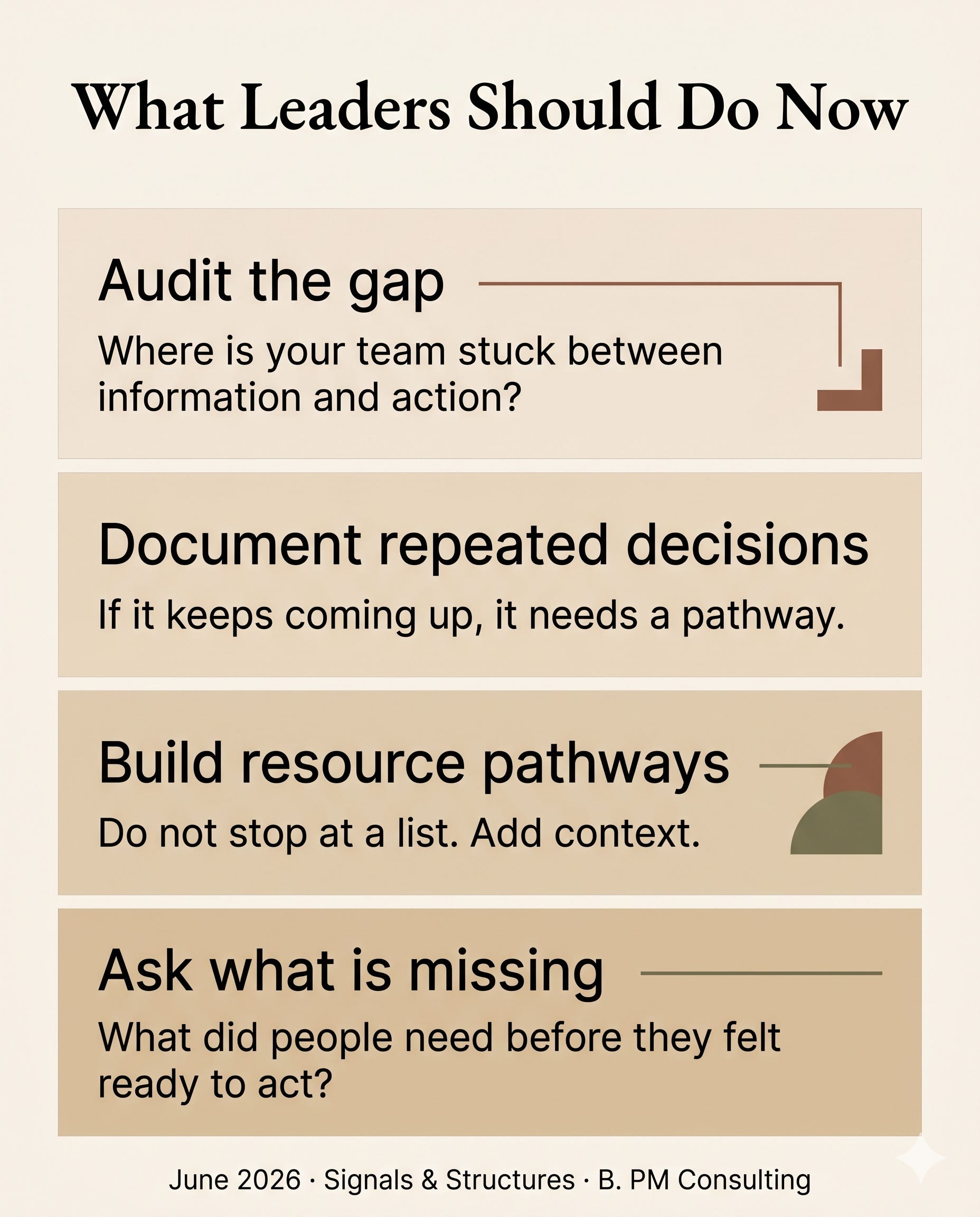
Audit where your team is stuck between information and action.
Look for places where people have access to resources but still wait, repeat work, or escalate decisions because the next step is unclear.
Identify which decisions are repeated but undocumented.
If the same decision comes up every month, it deserves a pathway, not another meeting.
Create a resource pathway, not just a resource list.
A useful pathway explains who the resource is for, when it matters, how to use it, and what context someone needs before acting.
Ask where people need clearer context before they can move.
The best feedback question is not only “Did this work?” It is “What did you still need to know before you felt ready to act?”
Be a part of what’s next
The next layer of useful infrastructure will not only help people find more.
It will help people decide better.
That is what we are building toward — and we want the community to help shape it.