Signals & Structures | April 2026
B. PM Intelligence | Monthly Governance & Leadership Signal Report
The Room Just Changed the Rules
Six signals nonprofits can’t afford to miss this quarter.
The funders, regulators, and government agencies sitting across from nonprofit leaders this year are not asking new questions. They are enforcing old requirements — harder, faster, and with less patience for organizations that arrived without documentation.
By January 2026, the Department of Government Efficiency had terminated 15,887 federal grants totaling approximately $49 billion — not future appropriations, but grants already awarded, already staffed, already mid-execution. The $236 billion in annual federal clawback exposure documented by the GAO did not create new standards. What changed is the enforcement posture — and it is now uniform across federal agencies, the IRS, state funders, and private philanthropy simultaneously.
For Executive Directors and the boards that fund them, the question is no longer whether governance infrastructure matters. It’s whether you built it before you needed it.
April’s Reality Check
The external environment has not introduced new standards.
It has changed how existing standards are enforced.
A federal dataset now reports 15,887 grant terminations totaling ~$49B, with data still being released incrementally and not yet fully reconciled across systems
Federal improper payment recovery remains in the hundreds of billions annually, with clawback mechanisms actively enforced
Recent federal litigation is raising questions about how grant decisions are executed, including the role of automated classification systems
Nonprofit leaders continue to report revenue pressure as their primary concern, despite increasing evidence that governance readiness determines access to that revenue
IRS exemption denials continue to reflect structural governance failures at the point of entry
The shift is not theoretical. It is operational.
April’s Intelligence
1. Large-Scale Grant Termination Is Now Operational
Signal
DOGE’s public savings tracker reports 15,887 federal grant terminations totaling approximately $49B, with the dataset still being released and subject to reconciliation across federal systems.
Interpretation
The precision of the number is less important than the mechanism it represents:
grant termination activity is being executed at scale and speed not previously typical in the nonprofit funding environment.
Implication
In that environment, compliance is no longer a periodic review function.
It becomes a continuous, documentable state.
(Granted AI, March 1, 2026 / DOGE)
2. Clawbacks Are a Standing Mechanism, Not a Scenario
Signal
The Government Accountability Office continues to report hundreds of billions in improper payments annually, with recovery processes triggered when compliance cannot be demonstrated.
Interpretation
Clawbacks are not rare enforcement events—they are a core function of the system.
Implication
Organizations without documented compliance ownership are not exposed to risk—they are already inside a recovery system they cannot respond to.
(Congress.gov / Congressional Research Service)
3. Governance Structure Is Being Evaluated as Evidence
Signal
IRS Form 1023 denial patterns continue to reflect:
concentrated decision authority
lack of board independence
absent conflict-of-interest controls
Interpretation
Governance is not being evaluated as internal hygiene.
It is being interpreted as evidence of organizational legitimacy.
Implication
Structural deficiencies are no longer correctable post-entry.
They are disqualifying at entry.
4. Funding Complexity Is Fragmenting Compliance Environments
Signal
Federal funding continues to shift toward distributed, state-administered structures, increasing variation in compliance expectations across jurisdictions.
Interpretation
The funding environment is no longer governed by a single compliance logic.
It is becoming multi-system and fragmented.
Implication
Organizations that rely on implicit knowledge or informal processes cannot adapt.
Only those with explicit, portable documentation systems can. (FundRobin)

5. Decision-Making Systems Are Outpacing Governance Systems
Signal
Court filings in ACLS-AHA-MLA v. NEH allege that grant terminations were executed using automated classification prompts, raising questions about how decision criteria were applied and governed.
Interpretation
Whether or not the claims are upheld, the signal is broader:
decision-making systems—administrative or automated—are scaling faster than the governance frameworks designed to oversee them.
Implication
When that gap exists, accountability does not disappear.
It shifts to the organizations being evaluated.
(PR Newswire / ACLS-AHA-MLA v. NEH, March 7, 2026)
6. Revenue Pressure Is Masking a Readiness Gap
Signal
Recent sector data shows nonprofit leaders remain primarily focused on financial sustainability and revenue acquisition.
Interpretation
Revenue is being treated as the constraint.
In practice, readiness is the gating factor.
Implication
Organizations are not losing funding because they are underfunded.
They are losing access because they are under-structured. (Urban Institute)
The Pattern
Across federal agencies, the IRS, and funding institutions, a consistent requirement is emerging:
Show the structure.
Show the ownership.
Show the documentation.
These systems are not coordinated.
But they are converging on the same evaluation criteria.
What was previously considered:
best practice
operational maturity
“good governance”
…is now functioning as a baseline filter.
Organizations that cannot produce:
named decision ownership
documented authority structures
explicit compliance controls
current governance records
…are no longer delayed.
They are excluded.
Structural Shift
This is not a compliance cycle.
It is a selection mechanism.
Before: governance differentiated strong organizations
Now: governance determines which organizations are allowed to participate
What Leaders Should Do Now
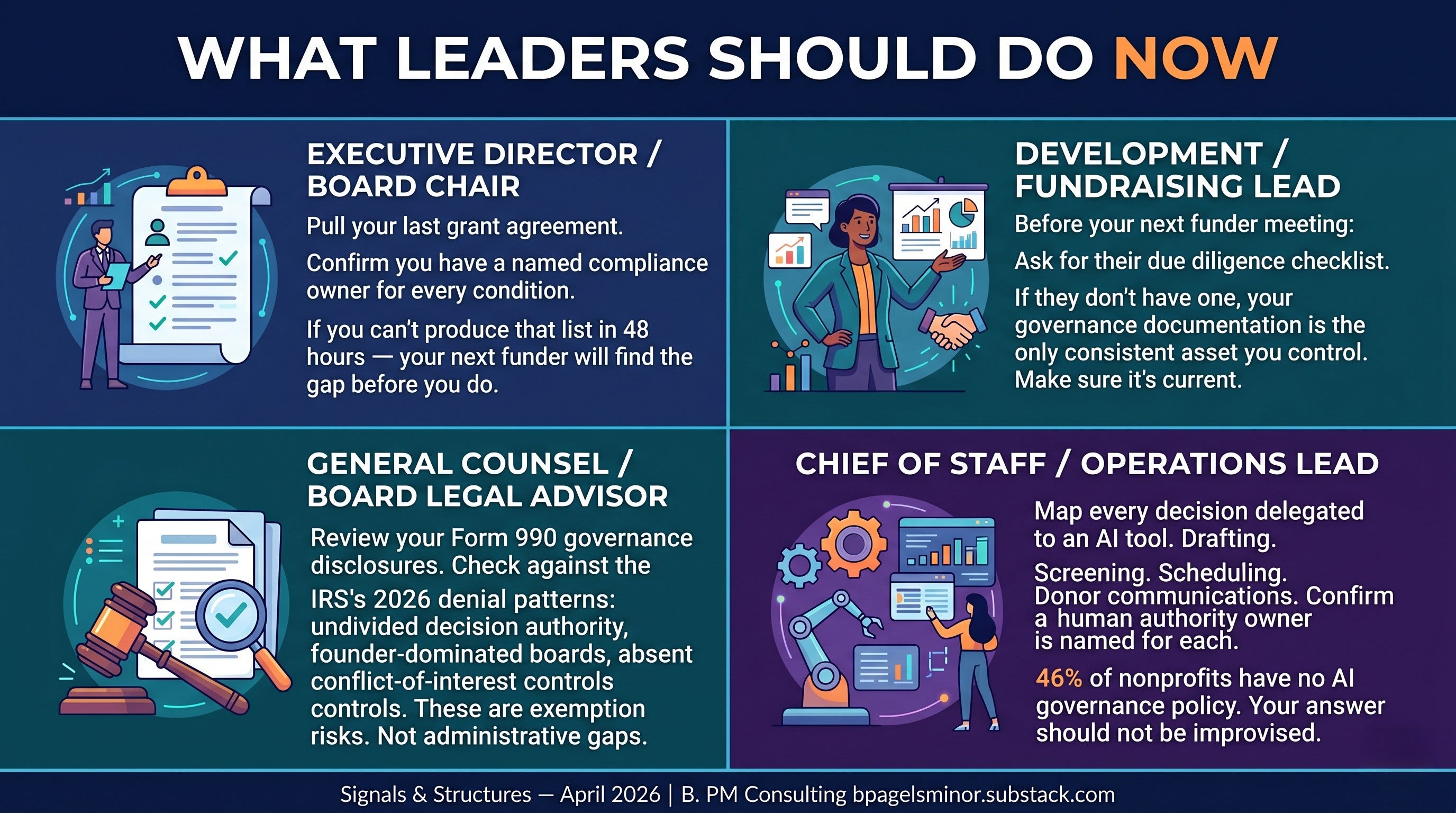
Executive Director / Board Chair: Pull your last grant agreement and confirm you have documented compliance owners for every condition — not assumed owners, named ones. If you cannot produce that list in 48 hours, you have an accountability gap your next funder will identify before you do. Run this exercise before your next funding conversation, not after.
Development / Fundraising Lead: Before your next funder meeting, ask for a copy of their due diligence checklist. If they don’t have one — or it varies by program officer — your governance documentation is the only consistent asset you control. Confirm it is current, organized, and accessible in a single package.
General Counsel / Board Legal Advisor: Review your organization’s IRS Form 990 governance disclosures against the specific failure patterns flagged in 2026 Form 1023 denials: undivided decision authority, founder-dominated boards, and absent conflict-of-interest controls. These are enumerated exemption risks. If any apply, they are not administrative gaps — they are structural liabilities with a named enforcement mechanism.
Chief of Staff / Operations Lead: Map every operational decision currently delegated to an AI or automated tool — drafting, screening, scheduling, donor communications — and confirm a human authority owner is named for each. The 2026 Nonprofit AI Adoption Report found that 46% of nonprofits have no formal AI governance policy. Funders are beginning to ask this question during intake. Your answer should not be improvised.
From B.’s Desk
What we are seeing across organizations right now is not a funding contraction.
It is a selection shift.
Organizations are entering rooms—funder conversations, regulatory processes, institutional partnerships—and encountering a different evaluation standard than the one they prepared for.
Not because expectations are new.
Because enforcement is.
The gap is consistent:
Decisions are being made faster than documentation can be produced
Accountability is being evaluated before relationships are established
Governance is being interpreted before mission is understood
And in that sequence, most organizations are losing ground before they realize they are being evaluated.
This is why the conversation around “resources” is misdiagnosed.
The constraint is not access to capital.
It is readiness for scrutiny.
The organizations that are moving through this environment are not better positioned because they are larger, older, or more connected.
They are moving because they can produce:
clear ownership
documented authority
current compliance records
and traceable decision structures
…on demand.
That is the difference.
The Stewardship Lab is being built in response to that pattern.
Not as an accelerator in the traditional sense, but as a readiness environment—one that focuses on the layer most organizations postpone until it becomes a barrier:
entity clarity
governance structure
accountability mapping
documentation systems
Because those are no longer back-office functions.
They are now the interface between organizations and opportunity.
Details on the next cohort will be shared shortly.
If you’re working with a nonprofit founder navigating their first major funding conversation, or you’re an organization that knows it needs to get structurally ready before the next room — complete our inquiry form now and we’ll be in touch as soon as the program opens.
Institutional Spotlight
We’re formally introducing Jordan Franklin-Mansuo to the B. PM Brands team.

Jordan works at a critical but often overlooked layer: data integrity and structured intelligence. Bad data doesn’t just slow systems down — it breaks them over time. When governance documentation is scattered, when decision authority is unclear, when compliance ownership is assumed instead of named, the entire accountability structure corrodes from the foundation.
His work sits at the intersection of research, systems, and execution — ensuring that the information driving capital, relationships, and operations is accurate, aligned, and usable. Because at scale, clarity isn’t a byproduct. It’s the advantage.
Read his latest piece on why this matters:

Governance infrastructure is not a luxury for organizations that have arrived. It is the condition for arriving. The leaders reading this issue already know that. The ones who need it most are still treating it as optional.
Forward this to someone who needs the signal.
B. PM Consulting helps nonprofit founders and institutional leaders build the governance infrastructure their ambitions require. Learn more at: